Reporting and Measure Execution Model
oa-cohorts defines the core domain model for building reusable cohort logic, compiling it to SQL, and materialising time-stamped qualification events for downstream reporting.
Every executable unit ultimately resolves to a set of MeasureMember rows:
{person_id, episode_id, measure_resolver, measure_date}
That canonical shape lets reports, indicators, and dashboards reuse the same underlying logic while preserving timing and episode alignment.
Conceptual Layers
Layer 6: Report
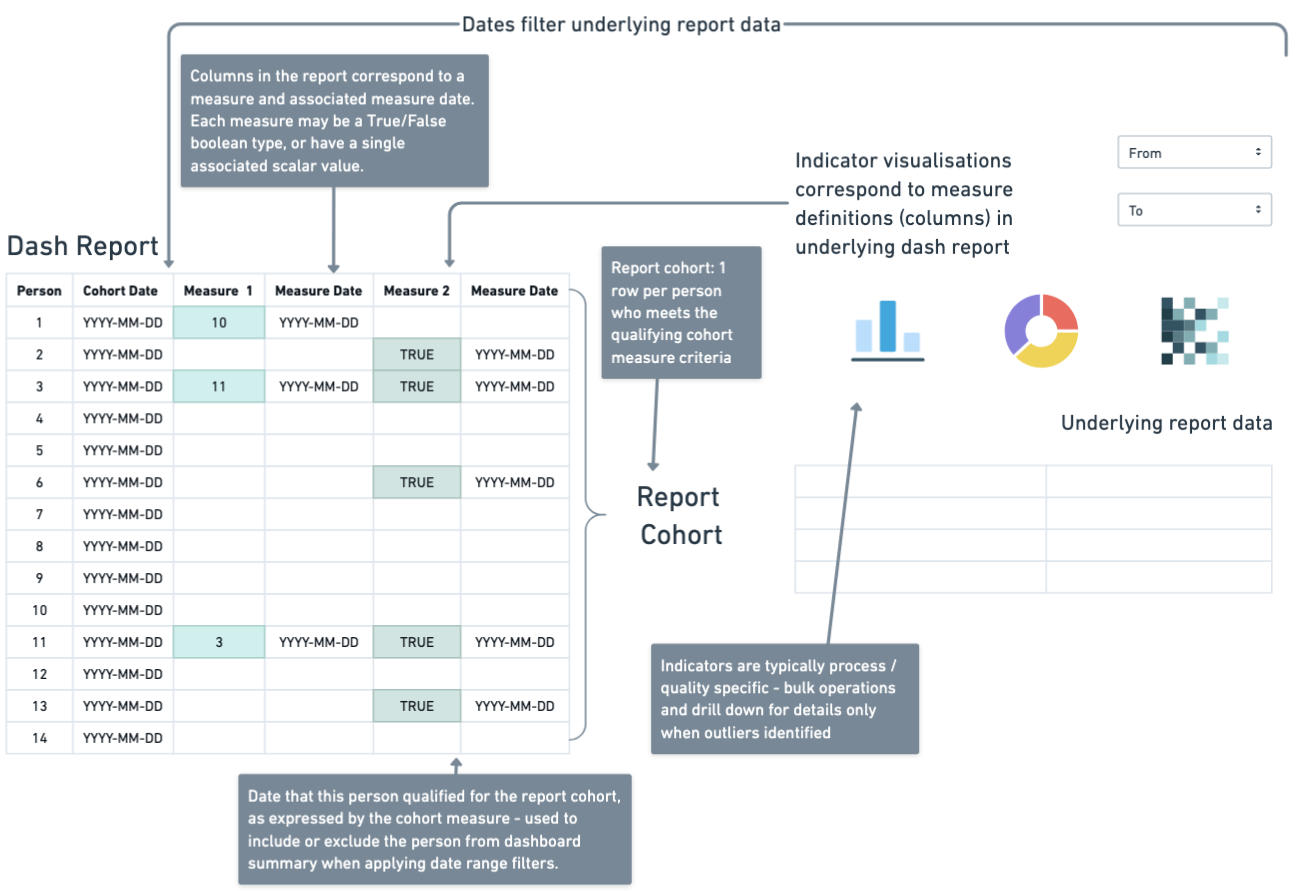
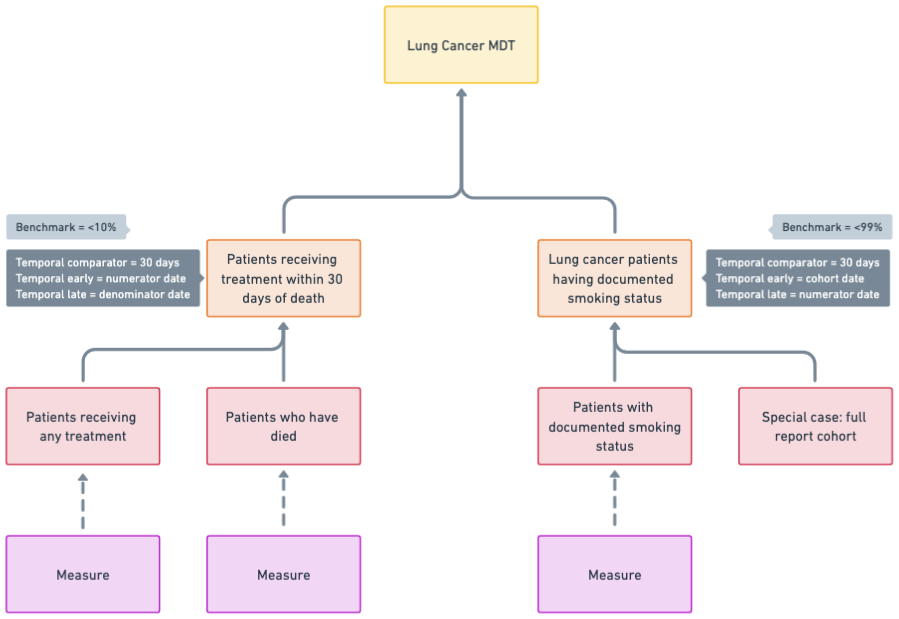
A Report orchestrates cohort and indicator execution for a specific reporting context.
Reports:
- group together one or more dashboard cohorts
- execute cohort and indicator measures in a coordinated way
- treat
measure_id = 0as the special "full report cohort" denominator - assemble final output rows with preserved numerator and denominator dates
Reports do not compile measure SQL themselves. They consume MeasureMember results produced lower in the stack.
Layer 5: Dash Cohort
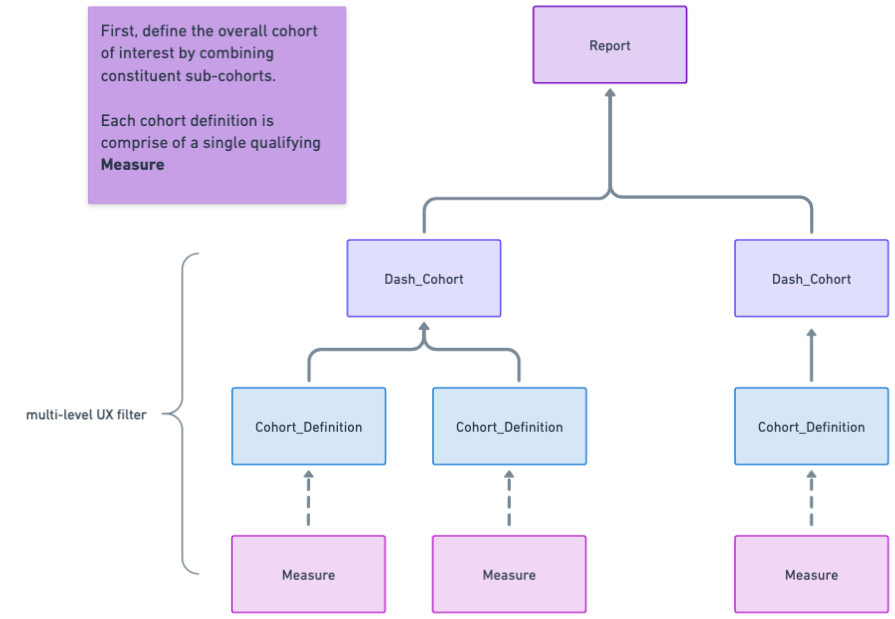
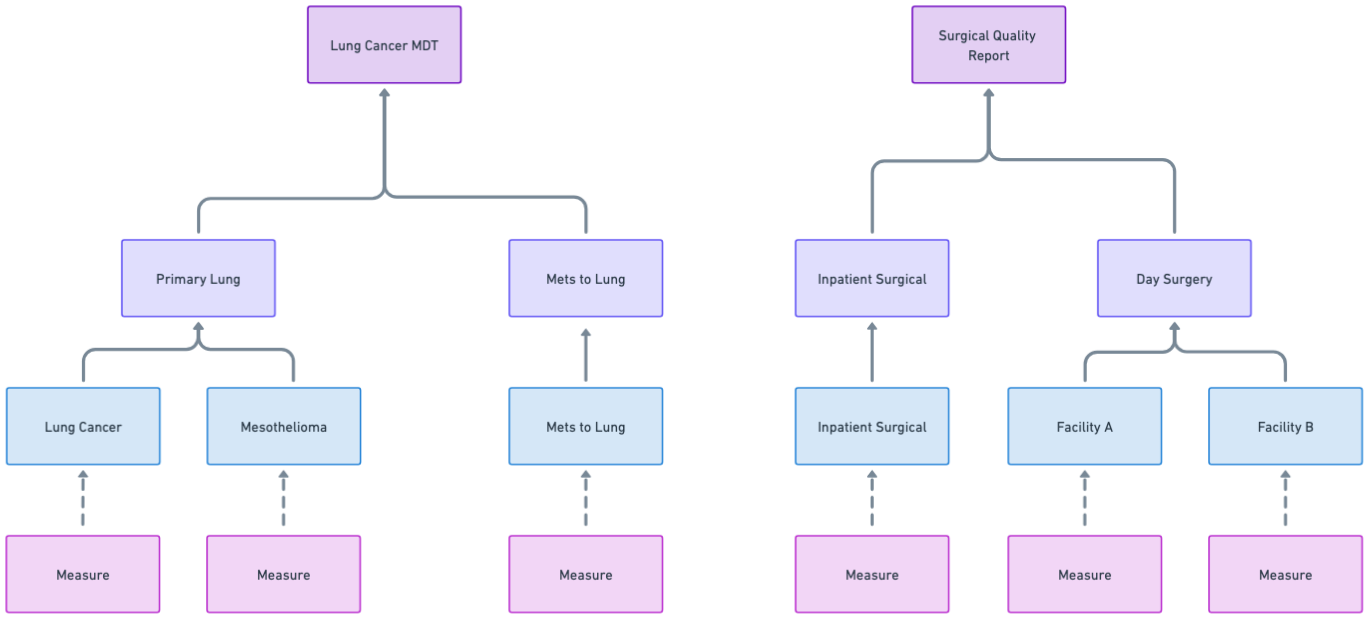
A DashCohort defines a clinically meaningful population by grouping one or more cohort definitions, each of which wraps a single measure.
A cohort's members are the union of its underlying definitions. In downstream reporting systems those definitions can be surfaced as sub-cohorts for filtering or drill-down, but their primary role is to create a stable population boundary for indicator logic.
Layer 4: Indicator
Indicators compose measures into:
- denominator: who is in scope
- numerator: which in-scope members met the target condition
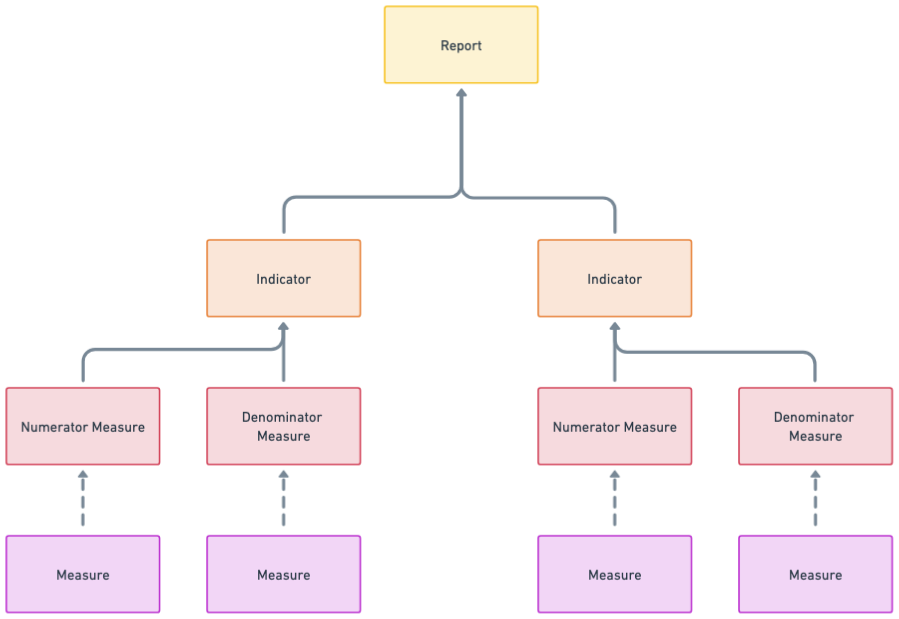
Both numerator and denominator resolve independently to MeasureMember rows. Final report payloads keep both dates:
denominator_datenumerator_date
Indicator-level relative date windows are applied during payload assembly, not embedded in reusable measure definitions. This keeps measures broad and reusable while allowing different reports to impose different timing rules.
Layer 3: Measure
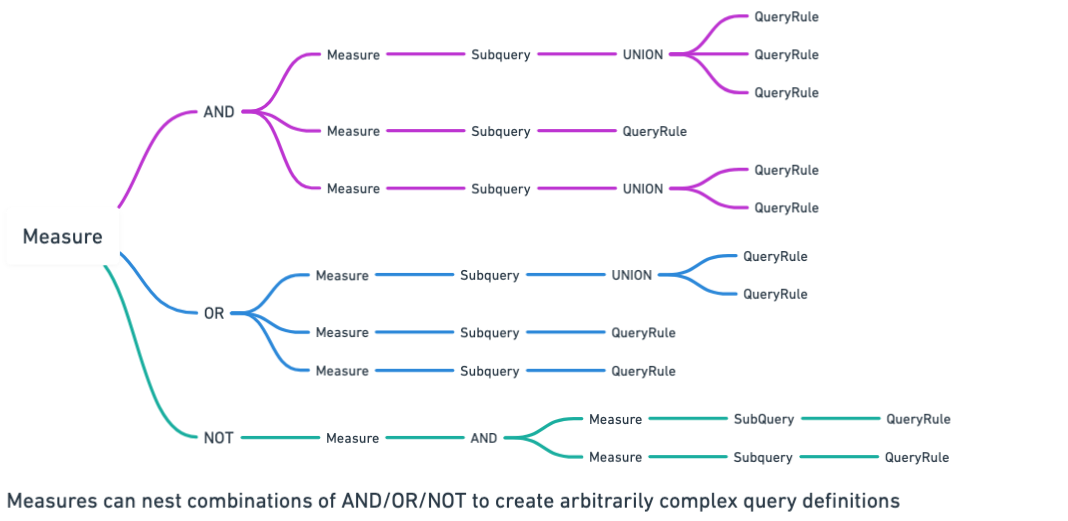
A Measure is a recursive logical node that compiles to SQL and produces MeasureMember rows.
Measures can be:
- leaf measures backed by a single subquery
-
composite measures backed by child measures
-
Leaf: wraps a single subquery
- Composite: combination of child measures via OR / AND / EXCEPT
- Temporal window: event B relative to event A, with configurable bounds and pick strategy (see
MeasureTemporalWindow)
Measures are compiled by MeasureSQLCompiler and executed by MeasureExecutor.
Layer 2: Subquery
A Subquery is the atomic SQL-producing unit.
It defines:
- a
RuleTarget - a
RuleTemporality - one or more
QueryRuleobjects
Subqueries are responsible for:
- resolving the measurable class for their target
- choosing the field that each rule should inspect
- generating
ANY,FIRST, andUNDATEDSQL variants
All subqueries emit the canonical measure-member columns:
| Column | Meaning |
|---|---|
person_id |
individual identifier |
episode_id |
clinical episode |
measure_resolver |
logical alignment key, usually the episode id |
measure_date |
date on which the criterion was satisfied |
Rule handling inside a subquery:
- each rule contributes its own
WHEREclause fragment - rule-level selects are combined with
UNION ALL FIRSTcollapses those candidate rows to the earliest qualifying date per resolver
Value-column resolution depends on the rule types present:
- exact, hierarchy, presence, and absence rules use a concept-like field
- substring rules use the measurable's string field
- predicate rules use the measurable's predicate field
- scalar rules always use the measurable's numeric field for threshold comparison
- scalar rules only require a concept field when at least one scalar rule has
concept_id != 0
That last point is important for derived window measurables such as tx_to_death_window and referral_to_specialist_window: threshold-only scalar rules can run against numeric-only measurables.
RuleTarget selection also carries clinical meaning, not just technical routing. For example:
dx_anyresolves against any diagnosis row attached to the current episodedx_primaryresolves against diagnosis rows anchored to the patient's primary diagnosis episode
That distinction lets report authors choose whether a cohort should follow episode-level diagnosis coding broadly, or whether it should stay anchored to the diagnosis present at the start of the primary episode of care.
Layer 1: QueryRule
A QueryRule is the smallest declarative unit in the engine: a single predicate applied to a field resolved by a subquery.
Examples:
- diagnosis concept equals X
- numeric value is less than Y
- predicate column is true
- concept code contains substring Z
A rule does not generate a standalone query. It only contributes a WHERE clause fragment within a subquery.
Why MeasureMember Rows Matter
The engine preserves qualification rows instead of reducing everything to a single boolean membership flag.
That supports:
- trend analysis over time
- indicator windows anchored to cohort membership dates
- episode-aware joins for
ANDlogic - multiple qualifying events per person when
ORlogic applies
This is the core design choice that makes the reporting layer flexible without forcing each report to redefine its own SQL.