Basic setup
Connecting directly via SQLAlchemy
OMOP_Alchemy does not require any special database wrapper.
You can always connect to your database using plain SQLAlchemy and work with engines, connections, and sessions exactly as you would in any other project.
import sqlalchemy as sa
import sqlalchemy.orm as so
from omop_alchemy.cdm.model.vocabulary import Concept

engine = sa.create_engine(
    "postgresql+psycopg://user:password@localhost:5432/omop",
    future=True,
    echo=False,
)

with so.Session(engine) as session:
    concepts = (
        session.query(Concept)
        .filter(Concept.domain_id == "Drug")
        .limit(10)
        .all()
    )
with so.Session(engine) as session:
    session.add(obj)
    session.commit()
Database configuration is handled by oa_configurator. See Configuration for how to set up ~/.config/omop/config.toml.
Loading files
load_file is the entry point for bulk loads. It reads the file in bounded batches, stages the rows, and merges them into the table. During the merge each backend relaxes foreign key checks where it can, and DuckDB, which cannot, validates the constraints it never enforces. Load parent tables before their children.
from sqlalchemy.orm import Session

with Session(engine) as session:
    MyTable.load_file(
        session,
        path="MY_TABLE.csv",
        dedupe=True,
        merge_strategy="upsert",
    )
    session.commit()
To insert ORM objects that reference each other without file loading, wrap the inserts in the backend's relaxed_foreign_keys. It relaxes foreign key enforcement and suspends autoflush for the block, restores them on exit and rolls back on error. Flush the inserts inside the block before committing outside it. DuckDB cannot relax its keys, so there the objects must be added parents first.
from orm_loader.backends import resolve_backend

with Session(engine) as session:
    with resolve_backend(session).relaxed_foreign_keys(session):
        session.add_all(objects)
        session.flush()
    session.commit()
Optional PostgreSQL full-text search
OMOP Alchemy can optionally integrate with PostgreSQL full-text search for selected vocabulary text fields.
This feature is not required to use the library and is an optional enhancement rather than part of the core OMOP schema.
At the library level:
- query helpers can fall back to inline
to_tsvector(...)expressions - optional sidecar
tsvectorcolumns can be registered into SQLAlchemy metadata when they exist in the database
At the database level:
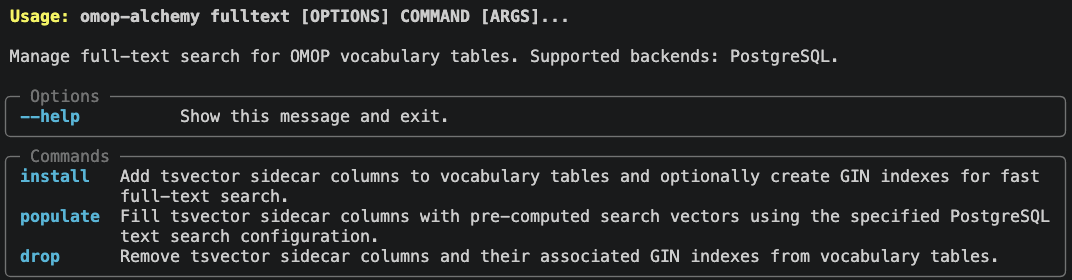
- PostgreSQL-only sidecar columns and optional GIN indexes can be managed through the maintenance CLI
- those sidecar columns are populated explicitly rather than auto-generated
Typical maintenance workflow:
omop-alchemy fulltext install
omop-alchemy fulltext populate
If you later reload vocabulary data, rerun:
omop-alchemy fulltext populate
For the full design and query patterns, see: