Overview on Federated Learning
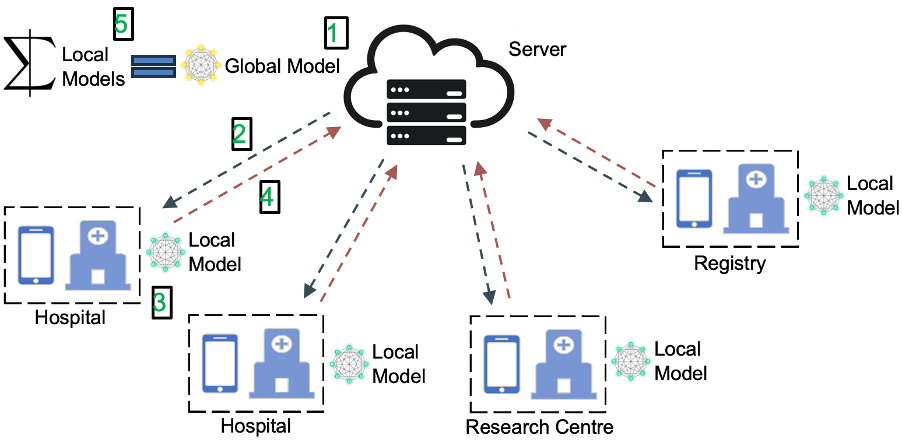
Federated Learning (FL) is a privacy-preserving approach to machine learning that allows hospitals, clinics, registries and research centres to collaboratively train models without sharing raw patient data. Instead of pooling sensitive medical information into a central repository — which raises significant privacy, governance and legal concerns — FL enables each organisation to keep data on-site while still contributing to a shared, high-performance model.
Federated Learning in Five Steps
-
Server initialises a global model — A central server creates or initialises a global machine-learning model containing parameters such as weights and biases that will be updated collaboratively.
-
Global model sent to clients — The server distributes the global model to all participating healthcare clients, such as hospitals, registries and research centres.
-
Local training at each site — Each client trains the received global model on its own local medical data (e.g., imaging data, electronic health records, pathology results). The data stays within the institution, and only the updated model parameters are produced.
-
Clients send local models back to server — After training, each site sends only the trained model parameters — not the data — back to the central server.
-
Server aggregates local models — The server aggregates (e.g., averages) the local models to generate an improved global model. This completes one communication round, and the updated global model is then redistributed for the next round until convergence.
Types of Federated Learning
Federated learning can be deployed in different ways depending on how data is distributed across institutions. In healthcare, three main types are commonly used:
Horizontal Federated Learning (HFL)
Clients share the same feature space (e.g., similar clinical variables) but have different patient populations. Hospitals training on similar electronic health record fields across separate cohorts is a typical example.
Vertical Federated Learning (VFL)
Clients share the same patients but hold different types of features about them. For instance, a hospital, pathology lab and insurer may each store different attributes for the same individuals, and VFL enables learning across these complementary datasets without exposing raw information.
Combined (Hybrid) Federated Learning
Clients may have partial overlap in both patients and features. Combined FL supports collaboration across complex, heterogeneous healthcare organisations by leveraging both horizontal and vertical relationships simultaneously.